
Anti-condensation membrane versus diffusion membrane
Published on 26.08.2026 · Isoflect Insulation technical team
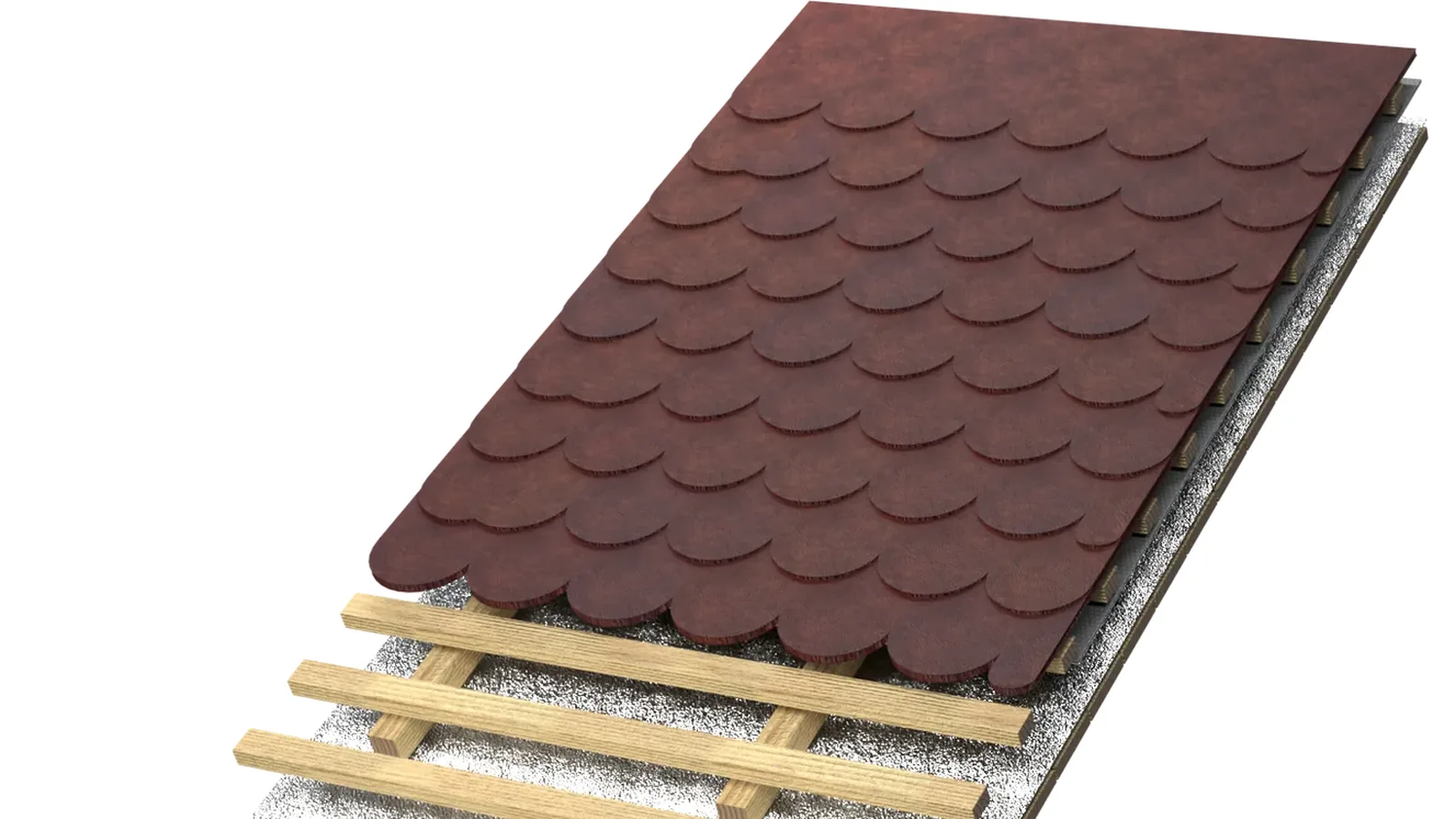
Beneath a metal, tile or shingle roof covering, a wrong choice is not immediately visible. Water can reach the thermal insulation through condensation, through minor leaks or through the vapour produced daily in the dwelling. For this reason, the comparison between an anti-condensation membrane and a diffusion membrane must be made according to the actual function within the roof, not merely according to the name on the packaging.
In practice, the terms are often used as though they meant the same thing. Some anti-condensation membranes are in fact highly vapour-permeable diffusion membranes installed beneath the roof covering. Others have a different structure, may have an absorbent layer or reduced permeability, and their installation requires a ventilation space. The decisive difference is the capacity of the material to allow vapour to escape from the construction while keeping external water away from the timber and the insulation.
Anti-condensation membrane versus diffusion membrane: the real difference
An anti-condensation membrane is usually defined by its role in protecting against the moisture that may form beneath the roof covering. It functions as a second line of defence: it stops the droplets formed on the underside of the roof covering and limits the ingress of rainwater or wind-driven snow into the roof structure.
A diffusion membrane has the same water-protection role, but is explicitly designed to allow vapour to escape from the thermal insulation layer towards the exterior. This property is expressed by the Sd value, namely the equivalent thickness of an air layer offering the same resistance to the passage of vapour. The lower the Sd value, the more open to diffusion the material is.
A low-Sd membrane can be installed directly over the mineral wool or over roof boarding suited to the system, without a ventilation space beneath the membrane, if the manufacturer permits this. It supports the controlled drying of the structure towards the exterior. A membrane with reduced permeability generally requires a ventilation channel between the insulation and the membrane. If that channel is blocked, vapour remains trapped and the risk of condensation in the wool and on the rafters increases.
Therefore, it is not the word “anti-condensation” that determines the solution, but the technical data sheet: vapour permeability, Sd value, water resistance, mass per square metre, mechanical strength and a clear installation recommendation.
When to choose a diffusion membrane
For a habitable attic, a diffusion membrane is in most cases the safe and predictable solution beneath the roof covering. In this zone, the thermal insulation is placed between and below the rafters, and the indoor air constantly carries vapour: from showers, cooking, drying laundry and the ordinary use of the dwelling. Even with a well-installed vapour barrier on the interior, a limited quantity of vapour can reach the insulation layer.
The diffusion membrane provides that drying path towards the exterior. It is particularly useful for pitched roofs with ventilated roof coverings and for renovations in which you wish to fill the space between the rafters correctly with insulation. The system is effective when each layer has a clear function: vapour control on the interior, insulation in the middle, diffusion and water protection on the exterior.
For a cold, non-walkable attic, the configuration may be different. If the insulation is laid on the attic floor slab and the attic remains ventilated, the emphasis is on the correct ventilation of the cold volume and on sealing the floor slab from the heated space. The membrane beneath the roof covering may still be necessary, but its selection must be coordinated with the type of roof boarding, the ventilation and the existing details.
When an anti-condensation membrane may be the appropriate choice
An anti-condensation membrane is a correct choice when its specifications match the structure, not because it is cheaper or more familiar to the installation team. For example, some systems beneath the roof covering use a membrane with reduced permeability together with a ventilated air gap. This gap must be continuous from the eaves to the ridge, so that moisture can be removed.
There are also systems for metal sheeting with an anti-condensation layer applied to the underside of the panel. The fibrous layer temporarily retains the condensation and releases it gradually when conditions allow evaporation. This is a different solution from the membrane installed beneath the roof covering and does not automatically replace all the layers required in a heated loft room.
In agricultural buildings, outbuildings, garages or unheated halls, where temperature differences produce droplets beneath the metal sheeting, an anti-condensation layer can significantly reduce dripping. In a house with a habitable attic, however, it is not sufficient to address only the condensation beneath the sheeting. The moisture migrating from the interior of the house towards the roof must also be managed.
A vapour barrier is not a diffusion membrane
One of the most costly confusions occurs when a diffusion membrane is installed on the interior in place of the vapour barrier. The two materials have opposite functions. The diffusion membrane is installed towards the exterior of the insulation to allow vapour to escape. The vapour barrier or vapour control membrane is installed towards the interior of the heated space, in order to limit the ingress of vapour into the thermal insulation.
The correct position of the layers is essential for absolute comfort and for the health of the structure. In an insulated roof, warm, humid air from the interior tends to migrate towards the cold zone. If the vapour reaches the wool and meets a cold surface, it may condense. Damp wool insulates less effectively, timber may accumulate moisture, and finishes may develop stains or mould.
Sealing matters as much as the type of membrane. Overlaps, cable penetrations, chimneys, roof windows and connections to walls must be treated with compatible tapes. A high-performance membrane that is perforated or left unsealed in critical areas cannot deliver reliable and predictable performance.
How to choose the correct material for the roof
Before ordering, establish the roof type and how the space beneath it will be used. A heated loft room, a cold attic, a roof with continuous roof boarding and a structure with standing-seam metal sheeting have different requirements. Then check the technical data sheet, not merely the product photograph.
Check the vapour permeability and the Sd value, but also the water resistance, tear behaviour, UV stability during installation and compatibility with the roof covering. For a membrane installed over thermal insulation, diffusion capacity is a priority. For a membrane with a higher Sd, the ventilation beneath the membrane must be designed.
Installation must be carried out with the side indicated by the manufacturer facing outwards, with correct overlaps and with counter-battens creating the ventilation space between the membrane and the roof covering. Water that accidentally reaches beneath the roof covering must be directed towards the eaves, not left to stop at a joint or a penetration. Around roof windows and chimneys, the drainage details are as important as the membrane itself.
Do not size the system solely on the price per roll. A correctly chosen membrane can protect tens of square metres of wool, rafters, plasterboard and finishes. By contrast, remedial work in a loft room after condensation appears often involves removing the finishes, drying the structure and replacing the affected insulation.
A good solution works as a system
Beneath the roof covering, the membrane does not work on its own. The result depends on the roof ventilation, the continuity of the thermal insulation, airtightness and vapour control from the interior. If any one of these elements is missing, moisture will find the most vulnerable path.
For renovations and new loft rooms, Isoflect can assist in configuring a package adapted to your structure, so that the membrane, the insulation and the sealing accessories have compatible roles. A question asked before installation costs little. A dry, well-ventilated and correctly sealed structure protects your investment for years of comfortable use.
Not sure which Isoflect product suits you? See Reflectiva Roof Pro or open the package configurator to find out exactly what you need and in what quantity.